AI Marketing Automation for Small Teams: What I Automate and What I Still Do by Hand

 15 Oct 2026
 Reading Time : 7 Minutes
This article explores how small teams can use AI marketing automation to simplify everyday marketing tasks, save time, and maintain consistency. From drafting content and scheduling social media posts to monitoring competitors, tracking performance, and automating welcome emails, Pablo Diaz shares his practical experience with AI-powered workflows. The article also explains why human oversight remains essential for customer conversations, brand messaging, fact-checking, and strategic decisions, while highlighting how ContentMation helps bring content creation, scheduling, competitor monitoring, and performance reporting together in one place.
A while back I went a whole week without posting anything. Not on LinkedIn, not on the blog. Nothing. I hadn't planned a break; it just sort of happened. Monday went to a billing problem and Tuesday to a call that ran long, and by Thursday night I was at the kitchen table rewriting the same caption for the fifth time. (The first version was the best one. It usually is.) I shut the laptop and told myself I'd catch up on the weekend.
I didn't.
Sound familiar? If you do marketing for a small business, or you basically are the marketing department on top of two other jobs, I'd guess you know that week well. For me, the problem is almost never a shortage of ideas. My notes app is a graveyard of half-finished hooks. What gets me is everything between the idea and a live post: writing it, reworking it for each place it must go, finding a slot, and then remembering to publish the thing.
So, for a while now I've been handing that grind to AI tools. Some of them have worked really well. Some of it went badly enough that I switched it off within a few days. This is where I've landed for now. Please don't read it as a framework, because I'm still changing my mind about parts of it.
The Question I Ask First
Before I automate anything, I ask a dull question: would a good result look roughly the same every time?
Turning a blog post into a handful of social posts? Mostly, yes. Scheduling them? Sure. Pulling the numbers on Monday morning? Definitely. Answering someone who's upset because they got charged twice? No. Not even close. That one depends on who they are and what went wrong, plus context no tool has.
If the answer is yes, the software can have it. If it's a no, a tool can help me think it through, but I make the call and my name goes on it. Almost every time automation has burned me, something from that second group had slipped into the first one without me noticing.
The worst one was an automatic reply to a comment. The comment was sarcastic. The reply was very, very cheerful. You can imagine how that went.
What I Hand Off Now
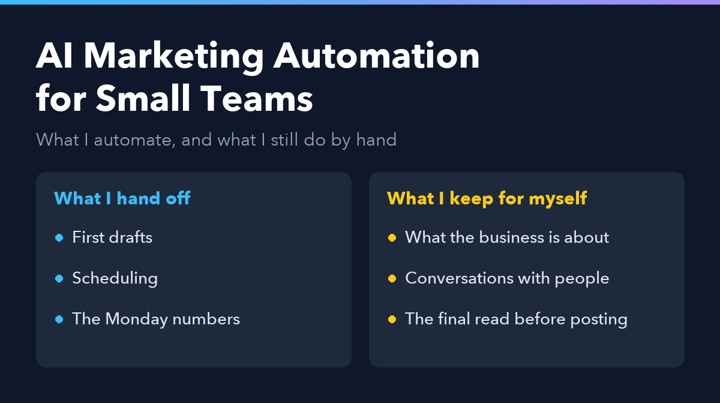
Drafts, mostly. That's where I got the most time back, by a mile
I almost never start from a blank page anymore. I'll take something I've already made, an old blog post or my notes from a customer call and have the tool to turn it into drafts for the week. Then I edit them, sometimes heavy. They're rarely good enough to post as they are, and I've stopped expecting that. But fixing a draft takes me a few minutes, while writing from scratch used to eat most of the evening. I'll take that trade
Scheduling came next. Back when I posted by hand, anything I wrote on a Sunday for a Wednesday had a coin-flip chance of going out on Wednesday. Now I do one batch session on Sunday afternoon (the coffee always goes cold halfway through), approve what I like, and let it publish through the week. Having the month laid out on one screen also shows me my own bad habits. Once I realized I'd lined up posts about pricing three weeks running. Nobody needed that, least of all me.
Then the Monday numbers. I used to open a pile of dashboards and copy figures into a spreadsheet that, if I'm honest, nobody reads. Me included. Now four or five numbers land in one place on their own. Visits by channel, signups, trial starts, replies. More data is the last thing I need. What I wanted was a review short enough that I'd actually do it when I'm already behind.
A few smaller jobs went on autopilot after that. I get digested when a competitor changes its pages or its pricing, which I always meant to check and never did. New signups get a short welcome sequence, and any real reply goes straight to my inbox instead of a void. (Honestly, I go back and forth on whether the welcome emails are worth it. Ask me again in a few months. A scheduled check also flags the boring SEO stuff, missing titles and broken links mostly, before it quietly costs me traffic.
What I Keep for Myself
This side is smaller. It's also where people decide whether they trust you, so I'm stubborn about it.
The big one is what the business is about. Who it's really for, and what it will and won't do. A tool will spit out dozens of taglines in a few seconds, and a couple might even be decent. It still has no idea which customers you serve best. I wrote mine down on a single page one evening. Every tool I use gets a copy of it.
Then there are conversations: comments, DMs, support emails, sales calls. When I'm tired, I'll sometimes let a tool suggest a reply, but I read it before anything gets sent. People can smell templates, I think. And after the sarcastic comment thing, I don't trust myself to skip that step.
I also read anything public before it goes out, especially if there's a number or a promise in it. AI text reads so smoothly that my eyes slide right over the wrong bits, which is sort of the whole problem. I've caught more than one post describing a feature that wasn't there anymore. It takes two minutes. I haven't regretted one of them yet.
Money and direction stay with me too. Should I try paid ads this quarter? Is it time to raise prices? A tool can lay out the data, which helps. Still, those are betting with my own time and money, and when one goes wrong, I'd like it to be a mistake I made.
And the stories. The posts people answer, at least in my experience, have something in them nobody else could have written, like a launch that flopped or an opinion I was slightly nervous to post. AI is fine for tidying those up afterwards. Having them is still my job.
If You're Picking a Tool
You could stitch all this together from separate apps. Plenty of people do, and I did too for a while. It worked, sort of. My brief lived in one app and my calendar in another, and I spent a silly amount of time copying things between tabs late at night. When your whole team could split one pizza, that stuff eats real hours
These days I use ContentMation for most of it, and I like it. What won me over is kind of boring: everything lives in one place. It has a brand voice setting where I pasted my one-page brief, so drafts come out sounding more or less like me. They wait in a review queue until I approve of them. Whatever I approve goes out on schedule through the accounts I've connected. That approval step was the one thing I wasn't willing to give up. It also keeps an eye on competitors for me, and the reports show clicks and signups, not just likes.
When I look at any tool now, I ask the same plain questions. Can I approve each post before it goes live? Does it post where my customers actually hang out? Do the reports tell me about signups, or only about likes? And if it stops working for me, can I leave with my content? If a tool fails that first one, it's a no, however clever the drafts look. Steal those questions if they help.
If I had to start over from nothing, I'd give it a month and go slowly. I'd write the one-page brief first, even though it feels like homework. (It did to me.) Then I'd try drafting from old material, get everything into one calendar, and leave the competitor's alerts and welcome emails for last. When the month was up, I'd look hard at it next to the month before and drop whatever didn't pull its weight. Maybe a bigger team would draw these lines somewhere else. I really don't know.
I still miss a week now and then. The difference is that it doesn't mean starting from zero anymore. The next week's posts are usually already in the queue, waiting for me.
What's the one marketing chore you'd hand off tomorrow if you could? I keep changing my own answer.