What Is an AI Content Humanizer? A Complete Guide to How It Works and Why It Matters

 17 Nov 2026
 Reading Time : 6 Minutes

An AI content humanizer is a rewriting tool that reworks model-generated text so it reads the way a person writes, without changing the facts or meaning. This guide explains what makes AI text sound robotic, including predictable word choice, even sentence rhythm, and stock phrases, and how a humanizer corrects these by varying rhythm, replacing generic phrasing, and rebuilding structure. It compares humanizers with paraphrasers, explains why they matter for readers, editors, and writers whose work is wrongly flagged by detectors, and outlines where they are used. It closes with tips for choosing a good tool, checking accuracy, and using it responsibly within the rules that apply.
Read three AI-written paragraphs in a row. You start to hear it. Every sentence is the same length. Every point arrives in threes. Somewhere a word like "crucial" or "seamless" turns up to do work a person would never ask it to do.
Nothing in that text is wrong exactly. It just doesn't sound like anyone. Readers. So do AI detectors, which are built to measure precisely that sameness.
An AI content humanizer exists to fix it. This guide explains what a humanizer is, what it actually changes in a piece of text, how it differs from a paraphraser and why it has become part of how many people write.
A Humanizer, Defined in Plain Terms
An AI content humanizer is a rewriting tool that takes text produced by a language model and reworks it so it reads the way a person writes. The goal isn't ideas or different facts. It's the message, delivered with the uneven rhythm, specific word choices and natural transitions of human writing.
Most humanizers work in one of two ways. Some are web tools, where you paste a draft and copy back the result. Others run inside software through an API so a writing app or content pipeline can humanize text automatically without anyone opening a browser tab.
What Makes AI Text Sound Like AI
To understand what a humanizer changes it helps to know what its correcting. Language models write by predicting the likely next word. That habit leaves fingerprints.
Predictable word choice
Models favor high-probability words. Detectors call this perplexity and its one of the main signals they score.
Even rhythm
Human writing swings between long sentences and short ones. AI text tends to hold a steady middle length. That flatness is called low burstiness.
Stock phrases and structures
Certain openers, transitions, and constructions show up again and again in model output. Phrasly's guide to the 15 Phrases and Patterns AI Detectors Flag lists the most common ones, and it's worth keeping open the next time you edit an AI draft.
How an AI Content Humanizer Works
A good humanizer goes after those three signals directly than simply trading words for synonyms.
It Varies Sentence Rhythm
Long sentences get split. Short ones get merged or left punchy on purpose. The result has the stop-and-start movement of real writing.
It Replaces Generic Phrasing
Filler transitions and vague intensifiers are cut or rewritten. Abstract phrases get swapped for plainer, more direct wording.
It Rebuilds Sentence Structure
Clauses move, openings change, and paragraph flow shifts. This is the part that separates a humanizer from a basic paraphraser.
It Protects Meaning and Facts
The best humanizers change how something is said without changing what is said. Names, figures, dates, and claims should come out exactly as they went in. That's harder than it sounds.
Humanizer vs. paraphraser at a glance
| What it changes | Paraphraser | Humanizer |
| Word choice | Swaps words for synonyms | Replaces predictable and stock phrasing |
| Sentence rhythm | Mostly unchanged | Deliberately varied |
| Structure | Usually kept | Clauses and openings reworked |
| Main goal | Say it differently | Make it read as human-written |
| Detector result | Often still flagged | Built to address what detectors measure |
That last row is backed by testing. In one experiment, one QuillBot paraphrasing pass lowered one detector's score, but GPTZero still rated the text 100% AI, because the rhythm survived the rewrite. The full breakdown is in Can AI Detectors Really Spot Paraphrased AI Text.
Why Humanizers Matter
Readers Can Tell, and They Care
A 2026 Gartner survey found 49% of U.S. Consumers believe generative AI has made available content worse rising to 57% among Gen Z and millennials. Flat generic copy costs attention. Writing that sounds like a person keeps it.
Most AI Drafts Get Edited Anyway
HubSpot found 86% of marketers who use AI for written content edit it before publishing (HubSpot, 2024). A humanizer speeds up that editing pass leaving people to check facts and add insight of rebuilding every sentence.
Human Writers Get Flagged Too
This is the reason many people first look for a humanizer. Detectors misread human writing more often than most realize.
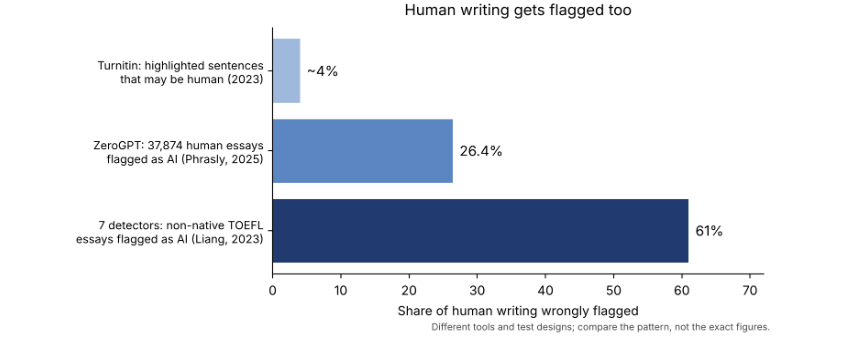
Turnitin has said roughly 4% of the sentences it highlights may be human-written (Turnitin, 2023). And a Stanford-led study found seven detectors flagged non-native English essays as AI about 61% of the time (Liang et al., 2023). For writers whose natural style reads as predictable, a humanizer can help genuine work sound like what it is.
Search Rewards Quality, Not Volume
Google doesn't penalize content because AI helped write it. It targets templated, mass-produced pages. The breakdown of why content gets penalized by Google puts phrasing across pages and unreviewed AI content high on the list. Humanizing breaks up that sameness though it can't add the insight Google also looks for.
Where Humanizers Are Used
Individual writers
Students, job seekers and professionals polish drafts, emails and cover letters so they sound like themselves.
Marketing and content teams
Teams humanize blog posts, product pages and email campaigns before review so editors spend time on substance than tone.
Products and platforms
Writing apps and content tools build humanization into their features. An automated AI content humanizer lets them do it through an API call with detection available.
How to Choose a Good Humanizer
Check accuracy before scores
Compare the input and output line by line on a samples. Any changed number or invented claim is a flag.
Test on your content
Run text you actually write through it then check the result with a sentence-level AI detector. Vendor benchmarks are a starting point, not a guarantee.
Look for control
Rewrite modes from light to heavy let you match the intensity to the draft.
Read the result out loud
If it sounds odd spoken it'll read oddly too. Good output should need edits, not a second rewrite.
Using a Humanizer Responsibly
A humanizer is an editing tool and the rules around AI still apply. Schools, employers, publishers and clients set their policies on AI assistance and some require disclosure. Use it to improve writing you stand behind and always check the facts yourself.
Conclusion: Making AI Drafts Sound Like People Wrote Them
An AI content humanizer rewrites model output so it reads like writing. It varies rhythm cuts stock phrasing and restructures sentences while keeping facts and meaning intact. That makes it different from a paraphraser, which mostly swaps words and often leaves the AI signal behind.
It matters because readers notice writing detectors misjudge even human work and nearly every AI draft needs editing before its ready. Used with a check on facts and, within the rules where you write a good humanizer turns a usable draft into something that actually sounds like you.